Showing posts with label zucchini. Show all posts

Monday, July 20, 2015

Harvest Monday 20 July 2015

squash&tomatoes


The Costata Romanesco is out-producing Dunja about 3 to 1. Of course it is cheating by trying to shade out its neighbor. It really needs at least a 5-foot plot of its own. And it tends to flop around. It is now lurching its way towards Dunja when it could of gone in three other directions. The tomatoes are Juliet which are starting to ripen now. This week I should also be picking Jaune Flamme and Esterina cherries.


broccoli


Last week I showed some nice heads of broccoli starting to form. Well, they did not get bigger, they did this instead. I am not sure what causes this, probably stress from the heat. At least they are easy to cut up for a stir fry. I have started more seeds for a fall planting which will hopefully do better. For spring planting I should probably plant a fast maturing type like Blue Wind.


mustard&squash


The mustard greens have started to bolt so this is my last cutting and I will pull those plants  The last of the lettuce was picked but not photographed. The rest has bolted and will be pulled. I also picked another 3 pounds of mostly snap peas. And I found another Romanesco squash hiding low under a leaf. This one is big, about 15 inches.


German_Red_garlic


The last of the garlic was dug and is now drying in the garage. This is German Red, a large hardneck that I purchased last year at the MDI garlic festival. Some of the bulbs are very large, with 4-5 cloves per head.


That’s what came from my garden last week. To see what other gardeners are harvesting, head over to Daphne’s Dandelions, our host for Harvest Monday.

Monday, July 13, 2015

Harvest Monday 13 July 2015


onions


It seemed like I tried to avoid the garden last week, but a lot happened despite that. Maybe I am just really efficient when I do visit the garden. So this post might be a little long, sorry. Let’s start with onions. The onion thrips essentially killed the White Candy onions so I pulled all of them to get them out of the garden (the white onions at the top). Everything else is doing OK. I pulled a couple of Tropea and Red Candy onions and a Super Star to use in cooking.


chard


I finally uncovered the cucumbers and chard and will take my chances with pests. The chard has again shaded the cukes so I trimmed just the offending leaves on the edges of the chard bed.


mustard_greens


The mustard greens also got a haircut and will probably be removed soon because they are starting to bolt. I may get one more cutting before that happens. I also pulled out all the Soloist cabbages which were riddled with holes and starting to bolt. Planting them without protection turned into a complete waste  of time and space.

Sunday, February 15, 2015

2015 Planting List

winter_2015


What a winter! Historic snow amounts and low temperatures. We have had 7 feet of snow in about three weeks (a foot of that this weekend) and are expecting another 1.5 feet Tuesday. Tonight it is supposed to be –6 °F (-21 °C) with high winds and –30 °F  (-34 °C) wind chill factor. Brrr.


All of  the seed orders are in and mostly delivered and safe inside. For those of you unfamiliar with suburban snow storms, mailboxes on the street are subject to being blown up by the town plows going by at high speed, throwing a plume of heavy snow that rips mailboxes off their supports and deposits them who knows where. The mere fact that my seeds have been safely retrieved and secured inside is a major accomplishment. The hell with the bills, my seeds are safe.


I am now working on the seed starting schedule, which is keeping me positive with all the nasty weather. Meanwhile, here is the planting list for Spring 2015, whenever (if ever ) it arrives. Seed vendor legend: BC=Baker Creek, DF=Dixondale Farms, F=Fedco, HM=High Mowing Seeds, J=Johnny’s, PT=Pinetree, R=Renee’s, SESE=Southern Exposure Seed Exchange, T=Territorial

Monday, August 26, 2013

Harvest Monday–26 August 2013

Sunburst


The Sunburst squash is continuing to produce a good supply of sunny yellow patty pans, but you wonder if it was named after the color of the fruit or the exuberance of its flowers. The other story in this picture is the persistence of the powdery mildew this year. I have sprayed with various organic-approved concoctions including Green Cure and Serenade, but the strain of mildew this year seems resistant to everything and does not go away and it is affecting even the “resistant” varieties like Dunja and Summer Dance.


four_firsts


Despite the powdery mildew plaguing most of the squash and cucurbits, I recorded four firsts this week: from the left, first Dunja zucchini, first Summer Dance cuke, first Green Fingers, and first Jackson Classic pickler, with more on the way if I can keep the vines healthy. The Crystal Apple cucumber has also set several fruit so I should be able to try those soon.


four_beans


Every couple of days now I am picking a large pile of beans, so I won’t show all of them. Above are the four types of bean I am growing this year. Top from left: Provider bush, Trionfo Violetto pole, and Fortex pole. On the bottom are the Jade beans which are just now coming into production after almost all of the first planting failed to germinate. In this photo you can see the difference in color from Provider and Fortex. Jade is a much darker green and one of my favorites. Below is a close up of Jade (top) and Provider.


two_beans


With all these beans coming in, there is pressure to do something to preserve them, even though a lot still go to the local food pantry. I don’t like freezing them. It’s a lot of work blanching them and I don’t like the mushy texture or even the taste, even when I vacuum sealed them. Forget canning them. Dilly beans are on my wish list but will probably not happen. I do make batches of stewed beans and tomatoes and freeze them, which works well. But then I ran across this article on freezing beans without blanching. It is simple enough, just trim the beans and throw in a zippered freezer bag.  I am trying this method this year as an experiment. I am also labeling the variety of bean so I can compare which type freezes better. Now I just hope we don’t have another week-long power failure this winter.

p> 

Finally, the Beedy’s Camden kale is prolific this year and is being used in many creative ways. My garden neighbor mentioned using it in a “massaged kale salad” and said her kids, who are otherwise allergic to the color green, like this salad. She described sprinkling chopped kale with salt and lemon juice and “massaging” it for 5 minutes, then adding olive oil. I’ll leave it to your imagination how you massage kale leaves, but I did try this classic method and it was very good. If you search the Internet for “massaged kale salad” you will find dozens of variations that can even turn it into a more substantial main dish. So there’s hope in getting through piles of kale like the one below.


kale


This is a sampling of what came from my garden last week. Check out what other gardeners around the world are doing in their gardens by heading over to Daphne’s Dandelions, out host for Harvest Monday.

Monday, September 24, 2012

Harvest Monday–24 September 2012

Nashoba Valley Winery, Bolton, Massachusetts

This week was a little different than usual. I did harvest the usual cukes, beans, and zucchini (photos at the end), but the garden is getting close to done. I have to clean up some of the beds to get ready for planting garlic next month. The big event for us happened Sunday when I signed up to pick wine grapes at our local winery, Nashoba Valley Winery, and suckered my wife and daughter into keeping me company.

I had to pay $18 per person for the privilege of working and we had to show up at 9:30 Sunday morning with gloves and shears. Perfectly reasonable. Over coffee and apple cider donuts Rick Pelletier, the owner, explained our task: pick 4-5 tons of grapes in 3 hours. Piece of cake. Our family was assigned to pick Vignoles, a white grape. Rick had hoped to pick it in two weeks when the Brix readings would have been closer to the desired 23 degrees, but the appearance of sour bunch rot required its addition to the day’s assignments. What’s another 2-3 ton of grapes? Besides, it was a gorgeous New England Fall day.

Here we are at the top of the Vignoles vineyard. Rick is explaining what to do and how to pick off or cut out the rotten grapes. Note the Segway with all-terrain tires Rick used to fly around supervising us while we lugged around 30-pound boxes of grapes by hand.

Richard Pelletier, Owner

Monday, September 3, 2012

Harvest Monday–3 September 2012

It’s definitely getting to be Fall. The days are cooler and the nights are colder.There are other signs around. Late August is when the garlic chives start blooming. The bed below started out as a small clump that I planted from seed and has self-seeded itself into a large bed (reminder to self: I have to remember to deadhead these things this year). The flowers are always a welcome sight, one of the few plants that bloom this time of year. They have a sweet, almost spicy fragrance that drives the bees wild.
Garlic (aka Chinese) chive blossoms

Bee on chive blossoms

Meanwhile, the garden is producing mostly cucumbers and zucchini, some oversized because I got to the garden a day late. The dark, slender cucumbers are Summer Dance. They are interesting in that they just grow longer, not fatter, the longer you leave them on the vine. Some of the ones below are over 10 inches long. They have a small seed cavity and probably would be good for pickles. The shorter, lighter green, cucumbers are Diva.

Jackson Pickling, Diva and Summer Dance cucumbers

Fortex pole beans and Dunja zucchini

Beans, zucchini and cukes

To see what other gardeners around the world harvested from their gardens last week, drop by Daphne’s Dandelions.

Monday, August 13, 2012

Harvest Monday–13 August 2012

Last week’s temperatures were more moderate but the humidity was awful, with dew points in the 70s. The air was so saturated that by the end of the week we started getting thunderstorms and even a tornado warning. When it did rain it poured buckets.The rain was needed but a lot of it just ran off. I didn’t do much in the garden but try to keep the squash and cucumbers picked, but I still got the occasional baseball bat. It was a pretty productive week and included my first beets and Brussels sprouts.

The tomatoes on the left are Black Krim. I had one left but it split badly after the rains. The plants are all dying from late blight so that is it for the Black Krims this year.

Black Krim tomatoes, cukes, and assorted cherry tomatoes

The three cukes on the left below are Summer Dance, which are proving to be very prolific. The tomato on top is my last Cherokee Purple (badly catfaced), which is also dying from the blight. The tomato below it is my first Pineapple.

Harvest assortment

More squash and cukes and my first broccoli from the second planting. The cukes on the right are my first Diva (one sort of got away hiding on the ground under the foliage). Diva is lighter (and thinner) skinned than Summer Dance and is now starting to climb and produce,

Assortment of cukes, squash and broccoli

A neighbor in the garden asked me if I wanted some Brussels sprouts. I said no, I am growing sprouts, but usually don’t harvest any until September. I thought I better check and sure enough, the bottom of the plants were more than ready to harvest. Some were a little over the hill but still will be eaten.
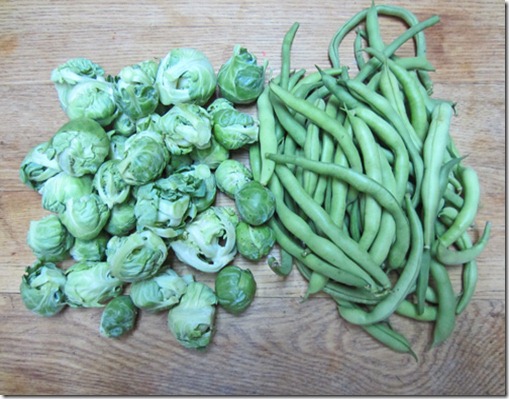
Brussels sprouts and bush beans

I got my first (small) harvest of beets. The beets have just been sitting there and not doing much. I don’t know if they don’t like the weather or what. These are Red Ace. The Bulls Blood are nowhere near ready to harvest but the greens are getting large enough to cut if I decide to go that way.

Beets and chard

I found a use for some of my accumulating Juliet tomatoes. It is summer in New England and that means bluefish, which is cheap and plentiful in the fish markets right now. This is a fish that seems to be limited to the upper Atlantic coast (I think it also is called sablefish in the UK and tailor fish in Australia). It’s not available on the west coast of the US and it does not ship well. Bluefish are a game fish that people love to sport fish because they are so aggressive and fight so hard. They swim in schools and feed voraciously on menhaden, which are very oily, so bluefish themselves are oily. I remember reading a news story of boaters in a marina on the North River south of Boston being startled when the waters of the marina started boiling and turned blood red. It was just some blues chasing a school of menhaden up the river.

Foil-baked bluefish with tomatoes and herbs

Bluefish is strongly flavored and not to everyone’s taste but if prepared properly can be delicious. Above I put the fish on an oiled piece of foil and covered it (you barely see the fish, but its flesh and skin are indeed blue) with lemon slices, onion, and sliced frying peppers and Juliet tomatoes from my garden. I added some fresh herbs from the garden and drizzled white wine and lemon juice on the fish, closed the foil, and baked it at 350F for 30 minutes. Everyone liked it and there was none left. Too bad because it is great left over for breakfast.

More squash and cucumbers. The large tomato below is my first Big Rainbow, a yellow-fleshed tomato with magenta stripes. I have three more of these on the vine so I will have a few more heirloom slicers for salads. It nicely decided not to split from the rain.
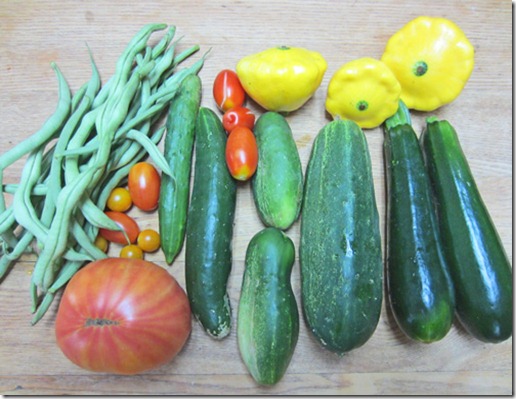
Harvest assortment with a Big Rainbow tomato

Finally, on Sunday I remembered I had to cut the basil. The large pile below is a sampling of what I cut. Some is being dried in a paper bag but the rest was turned into pesto. At the bottom are some other herbs; dill weed, used in a batch of pickles; spicy globe or Greek basil; Siam Queen Thai basil, to be used in Monday’s curry; and tarragon for some chicken salad.

Three types of basil, dill and tarragon

The pesto came in handy for pasta for my daughter, who doesn't like lobster (aw, too bad). It was too nasty to cook and for some reason (weather or the economy, I don’t know), lobsters have been ridiculously cheap. The local market had selects on sale for $6.99/pound with free steaming. While my wife was at the Bolton Fair, I stopped by the store and ordered up two of them. One was 2 pounds (obviously that was my lobster) and the other was 1.5 pounds. And they were hard shells, not the usual soft shelled ones you find in the summer. They were served with corn from the local farm stand and a tomato and cucumber salad from my garden. My wife scored a raspberry chocolate tart at the Fair which we had for dessert with a scoop of vanilla ice cream (totally blowing my low carb diet, but you only go around once). Pretty good finish to the week, I thought.

To see what other gardeners around the globe are harvesting from their gardens, head to Daphne's Dandelions, our hostess for Harvest Mondays.

Monday, July 30, 2012

Harvest Monday–30 July 2012

Not much to show this week. Tuesday was busy and by Wednesday I had some stomach bug that put me out of action for three days. First got to the garden on Saturday and found a few things overgrown, but everything is edible assuming my appetite comes back. We also have said several days of rain so I did not have to worry about watering.

I picked two pounds of beans, some of them a little large. Actually I welcome larger beans because it is a reason to make stewed beans with tomatoes. That’s comfort food to me and they freeze well, so a good way to use up the older beans and excess tomatoes.

IMG_1309

An assortment of small tomatoes, Juliet, Sun Gold, and Black Cherry. The cherries are very tasty but I’m not sure I like Juliet. Kind of tough and dry, not very flavorful. Fortunately none of the tomatoes split from the sudden rainstorms. I left a medium sized Cherokee Purple on the vine to sun-ripen for a few more days. Hope it’s still there. Yesterday I got an email from a fellow gardener who had surprised a poacher at the garden. This person drove their minivan right up to the gate of the community garden, got out with a shopping bag, and proceeded to do her produce shopping among the various plots. Most items I have plenty of at this point, but I have special plans for that tomato.

IMG_1310

Some of the squash got away, which happens. They are actually larger than they look in this photo. I think these two types of squash are still edible when fairly large, but I really did not need more squash right now. I think I might try stuffing the zucchini and turning it into a main dish. The cucumbers are two pickling cukes.

IMG_1311

I got some bad news while picking the beans. I noticed some small discolorations on some of the beans, like a wet spot. As I got down the bed, I found the reason. In the picture below you can see black lesions on the beans, sure sign of halo bean blight, a bacterial bean disease from infected seed (see an earlier post). The wet looking spots are the early stage of the infection. As it progresses, a lesion appears with a cream-colored center. You can see that on the bottom bean on the right. As the infection proceeds, you get the sunken lesions you see on the top, which turn black from secondary infection. I was surprised because usually the leaves are affected first, with brown lesions surrounded by a yellow halo, but this hit the beans first.

IMG_1312

This is a bit disappointing. I cleaned up the garden debris last year and the disease is not supposed to overwinter in New England. I rotated the beds and made sure I had seed from reputable sources. And it is supposed to be less likely to infect bush beans. All I can do is remove infected plants and hope it doesn’t spread further (wet, windy weather like we had the past few days will do it).

That is all from here. To see what other gardeners around the world are harvesting from their gardens, head to Daphne’s Dandelions and join the fun.

Tuesday, June 12, 2012

Squash Vine Borers

Squash vine borers (SVB) are larvae of the SVB moth that bore into the stems of cucurbits (squash, cucumbers, melons) and work their way up the stem. You can tell you have borers when your plant suddenly wilts. Check the stem about an inch and a half up from the ground and you will see a small hole with sawdust around it where the borer entered.

Once the borer is in the squash, the plant is at great risk. If you catch it early enough, you can slit the stem with a razor knife from the entrance hole up to where the borer is and destroy the borer with the knife blade or a wire. Then bury the slit stem under soil to keep it covered. This may or not be successful, but if you do nothing, the plant will die. If the plant can’t be saved, pull it and destroy it. You can replant squash in early July after the SVB threat is over.

The best method is to prevent the SVB from laying eggs near your squash, or provide a physical or biological barrier. If you can cover your plants with floating row cover, that keeps the moths from laying eggs near or on the plant. It also wards off squash bugs. But the cover has to be removed when the plant starts flowering so pollinators can get to the flowers.Last year I kept my squash covered, even hand pollinating them for a while.. This year with varieties like Costata Romanesco, which grow very large, I am not sure if I will be able to keep them covered for long enough, so I am interested in other possible prevention techniques.

The SVB moth does not look like a moth but more like a wasp or bug. It emerges from a cocoon in the soil the end of June or beginning of July (but remember we are way ahead of average on degree days because of the mild winter and spring). These moths fly during the day and are very good fliers, more like a wasp. They stand out because of their coloring so keep a lookout for them.

Squash vine borer moths

The moth lays single brown eggs on the stems of the cucurbit. When they hatch, the larvae tunnels into the vine about an inch or inch and a half off the ground. The borer itself is a big, fat, ugly thing, shown here in this cross-section. These pictures are courtesy of the University of Minnesota Extension (see http://www.extension.umn.edu/distribution/horticulture/M1209.html for their advice on SVB management).

Squash vine borer maggot

Here is an interesting video that suggests using cardboard tubes to prevent the borers from physically reaching the stem and boring into the plant.


Other suggestions are to wrap aluminum foil around the stems at the soil level and several inches up. Another, more elaborate technique is to inject the squash stems with a Bt (Bacillus thuringiensis) solution, inoculating the insides of the stems with Bt, which will kill the borers when they try to enter the stem. Does anyone have experience with these prevention methods? I am curious to know if they really work.

This was originally posted on the Bolton Community Garden Blog and is re-posted here because I thought the information might be useful.

Sunday, June 10, 2012

Garden Update 20 June 2012

It has been two weeks since my heavy planting effort on May 26-27, the Memorial Day weekend. All of the transplants survived and are actually thriving, despite the cool, cloudy, rainy weather. I did not have to worry about the keeping the seeded beds moist. All the rain took care of that for me. I did worry about the bean seeds, which prefer a warm, fairly dry soil of at least 60° F (16° C). That planting weekend was warm and sunny but early this week we had overnight lows in the forties. Nonetheless, everything has now germinated and is doing well.

Speaking of beans, the pole bean Fortex was one of the first to come up. They are going to be trained up a trellis on the left. The rest of the box has my kale and collards transplants along with a few remaining kale plants from last year. I have been planning to remove the old plants, so I shear them of leaves and come back to find them looking like this. I’m getting buried in kale. I also need to get them doused with bT and covered with row cover to ward off the cabbage moths floating around the garden now.

Fortex pole bean young plants

Tuesday, July 26, 2011

Harvest 25 Jul 2011

After the lethal weather of last week (108°F on back porch in the shade), the weather has moderated. We had thunderstorms on Saturday which brought in cooler and cloudier weather. It rained a bit on Sunday and again on Monday, which relieves me of the need to water the raised beds. In fact, the cooler weather has allowed me to transplant some seedlings to replace the Romaine lettuce and the pac choi Shuko which have been harvested, and to add some more Swiss chard (I have terrible luck with chard).

My summer squash are still under floating row cover to ward off the squash bugs and vine borers, but they are starting to produce blossoms. I am reluctant to remove the cover because the squash bugs are now at peak around the community garden, but I have to deal with pollination. On Saturday I tried to hand-pollinate the zucchini by using a piece of jute twine as a swab to transfer pollen from a male flower to my first female flower. Time will tell, but I think I may have succeeded given the dark green color of the fruit, compared to the light green color of the baby fruit to the right below the female flower. Today I used a cotton swab from the pack I am now carrying in my garden basket to hand pollinate two more female zucchini blossoms.

First zucchini

Sunday, July 10, 2011

Garden Update week of 5-11 Jul 2011

sfg_bak_5Jul

Because of the time taken to build and fill the beds and our trip to St. Louis,the garden was planted fairly late this year. Then add in many days of cold, rainy weather with no sun and the garden was looking poorly. Lately, after some stretches of warmer, sunnier weather, plants are starting to green up and grow. Of course, the lettuces have loved the weather and we have been having salads almost every night. Overall, the garden is looking good and is starting to catch up with the neighbors.

As you can see, the tomatoes (the only plants not in raised beds) are looking great. The Brandywine is growing well and already has a fairly large fruit. The Cherokee Purple and Sun Gold are also growing strongly and setting fruit. Several of the Jet Stars are also flowering and have small fruit. The Romas in the cages look healthy but are taking their time while hopefully developing a good root structure.

Thursday, July 7, 2011

2011 Planting List


This is a list of what I planted in the eight raised beds and in the strip of garden allotted to tomatoes.

Box 1 (3x6)
  • 1 zucchini Raven (9 sq)
  • 1 pattypan squash Sunburst (9 sq)
  • 4 lettuce red leaf (1 in each corner)
Box 2 (3x6)

  • 5 broccoli Green Comet
  • 2 Brussels sprouts Jade Cross
  • nasturtium Alaska
Broccoli and Brussels sprouts


Template developed by Confluent Forms LLC