Showing posts with label onions. Show all posts

Monday, September 26, 2016

Harvest Monday 26 September 2016


I finally got enough Ancho Poblanos to make a batch of chilies rellenos this week. The plants are a meter tall and very healthy, but unfortunately the weather is getting colder. It is 40 F/4.5 C this morning, which is getting uncomfortably close to freezing. The mature pepper plants can endure a little cold weather as long as we don't have a killing frost. Seems we are never lucky in that respect.  Also in the pile is a Melrose sweet red pepper, a pile of Jimmy Nardello, and a ripe jalapeno.


Another boring basket of cherry tomatoes. I already had a large number of these in the refrigerator from our Acadia trip. I ran out of time to process them so I threw two bags of them in the fridge, following Mark's lead. One bag was then slow roasted and frozen. The second bag went into the blender for gazpacho, along with onions, peppers, summer squash, and a chili. I used some of the suspect red onions I had set aside, the ones with the apparent bruise on the side.


You can see the flat spot on the top of this onion. The spot is flat but does not seem soft. I don't remember dropping any of the onions, and even so the onions are rock hard and wouldn't show a mark unless they were whacked hard. In fact, they had these spots when they were harvested.


On peeling the onion, you can see the black mold growing under the skin. So it was a good idea to set these aside and not put them in the onion storage bin. The mold must have caused the flat spots by collapsing the onion cells on the surface.


Slice off the infected spot and you can see the mold has not yet penetrated the interior of the onion, so the onion is still good. I only have  a few more to use up.


I also used garlic in the gazpacho and was disappointed to find some of the bulbs are already starting to soften and dry up. Unfortunately I just grabbed a bulb and did not notice which variety it was. From the same head, the two cloves at bottom right were white and juicy, the two at the top had yellowed and softened but were still used, and the clove on the left was brown and nasty and was tossed. So I have to get on with trying to preserve some more of the harvest this week. I plan to slice and dehydrate some, and I will also try roasting a number of whole heads and freezing them. I tasted one of the fermented cloves I made and it was eye opening. Very pungent but the clove was still firm and could be used in cooking.

That is what happened in my garden last week. To see what other gardeners around the world are doing, visit Dave at Our Happy Acres, our host for Harvest Monday.

Monday, August 29, 2016

Harvest Monday 29 August 2016


I had a few random pickings from the garden last week, including the first Jimmy Nardello pepper. I continue to bring in the tomatoes as soon as they color a bit to save them from the birds. My mother-in-law had a suggestion for the birds. She used to hang red Christmas ornaments in the vines. The birds peck on the hard red ball and get frustrated. They eventually leave the tomatoes alone. Haven't tried it yet.


The Black Beauty tomatoes are starting to ripen on the counter and we have had a few. They are indeed like the Indigo series of tomatoes, where they turn black on areas of the skin exposed to sunlight and are green elsewhere. The green sections ripen to a red color. The tomatoes are tasty but not up to the hyperbole of the Baker Creek catalog. I am hoping to get one riper than this to taste but a lot of them are rotting from bird pecks so they have to be eaten sooner.


I cleaned up and weighed the Red Wing onions that were drying on the back porch. It was a good crop and I got 27 storable onions weighing 5 pounds (2.3 kg.). Largest was a half pound.These store quite well, for at least 10 months or longer.


Unfortunately, a significant number of onions (10 onions weighing 2 pounds, about a kilo) had what looked like soft, flat spots on them. If you press on the spot it seems hard, but I kept these separate from the storage onions and will use them first.

In the garden I did get peas and spinach planted for the fall. The beds were bone dry down to the bottom so I had to re-hydrate the soil. It took 12 gallons of water to moisten 6 square feet of one bed where I put the snap peas and spinach. Unfortunately the drought continues and no rain is forecast for this week, so continuous watering of the seed beds is going to be necessary to get anything to germinate. At least the temperatures are more moderate, in the mid 80s F.

Sunday we went to the (third annual) Boston Fermentation Festival held at the Boston Public Market. I was surprised fermentation was popular enough that there was such an event. There is even a Berkshire Festival in Great Barrington in September but we will be at the MDI Garlic Festival. If you find one in your area and are interested in fermentation, they are worth attending. They have presentations and workshops. Interesting were the "mobs", where at various times and places they would set up a table with bowls and chopped vegetables and invite people to make their own jar of kraut or kimchi. And really nice, they had a starter sharing table where people would freely share their extra starters, like kombucha starter or sourdough starter. If you search for "fermentation festival" you will find events all over the country, and maybe one near you.

That's what happened in my garden last week. To see what gardeners around the world are doing, visit Dave at Our Happy Acres, our host for Harvest Monday.


Monday, August 15, 2016

Harvest Monday 15 August 2016

The garden benefited a bit from a few thunderstorms that dropped a little rain. These were mostly small storm cells that produced a quick shower that just evaporated immediately. We had one downpour on Friday that resulted in 1-2 inches, but a lot of that ran off the dry ground and prompted flash flood alerts. So the drought continues and daytime temperatures remain mid-90s to 100+ (35-40°C). The garden is still producing a little while  I still wait (apparently with everyone else) for peppers and tomatoes.


The Revolution bell peppers are starting to produce fruit. The peppers in general are doing the best in these conditions but are taking their time. The plants are stocky with lots of healthy foliage. However, they do not have a lot of time because that first killing frost is maybe 6-8 weeks away. A few of the tomatoes are starting to color, but unfortunately that is causing attacks by the birds. I doubt they are finding many wild berries in these dry conditions,. I picked a green tomato with a bird peck since it will just rot if left on the vine. I also picked the one next to it which was showing some coloring to see if I could ripen it on the counter.


This is a Pink Berkeley Tie-dye starting to show its green stripes. I am really looking forward to trying one of these so I need to try deploying some bird netting. The marketing hype on these says that 10 out of 10 customers at a farmers market taste-off preferred the flavor of these to Cherokee Purple. And so far other than the bird pecks, the fruits are perfect, no cracks or cat-facing or BER.


The Black Beauty tomatoes continue to size up but I still have no idea when one is ripe. I have tried squeezing them gently but so far they are all rock hard. The birds did attack these as well, eating half a mid-size tomato. That tomato's insides were green at the stem end and slightly pink at the blossom end, so no where near ripe.


These are the first two of my flea-bitten Golden Acre cabbages.  This is an heirloom compact cabbage that can be grown in a square foot, which makes it perfect for raised bed gardens. The cabbage on the right was my target since it had formed a dense head. Then I noticed the cabbage on the left had developed an elongated head and I was worried that was a sign of bolting, so it was harvested as well. They weighed a pound and a quarter and a pound and a half (.57 and .68 kg.), which is a nice size for home use. Initially the flea beetles were not a problem because they don't like the waxy surface of the leaves. But once their preferred targets were harvested or killed by the drought, they developed a new fondness for cabbage leaves, but damage was mostly to the edges of the outer leaves.


I declared the Red Wing onions to be done. They have not flopped but the foliage was looking sad and thrip-damaged, so I pulled them and laid them out to cure a few days in the sun. This happened last year with the Red Zeppelin onions. The red onions always take much longer than yellow to mature. Dixondale Farms says 100-120 days for Red Wing, 110 days for Copra. Both are long-day varieties which require long daylight hours to develop bulbs, which starts when the days shorten. They also warn that Red Wing requires a minimum of 15-hour days to bulb, which is no problem here. We get 15+ hour days in June and now in August that has dropped to 14 hours.


The Copra onions harvested a few weeks ago were cleaned and trimmed and put away in the basement. They were not particularly big, which is not surprising given the dry conditions, but they were very health. Thirty-one onions from 6 squares weighed in at 5.44 pounds (2.5 kg). I am thinking I will plant more onions next year so I produce more of my onion needs. I wasted a lot of garden space and my time trying to grow crops like beans, peas and turnips that failed in these dry conditions. Onions have been more reliable.

That's what happened in my garden last week. To see what other gardeners around the world are harvesting, visit Dave@Our Happy Acres, our host for Harvest Monday.

Monday, July 25, 2016

Harvest Monday 25 July 2016


I pulled the rest of the beets and radishes. There are a few beet and turnip seedlings left in the beds but I don't know how they will do with the relentless heat and dry conditions. The jalapenos are starting to produce, since it has been hot but not so hot to cause the pepper blossoms to drop.


I also harvested the last of the Napa cabbages. They were small but dense and the two together weighed over 2 pounds (about a kilo). Not a lot of slug damage on them, so maybe the dry conditions are dispatching some of the slugs. I also took the rest of the kohlrabi since they were not looking happy and I didn't want them bolting on me.


 The Copra yellow onions flopped over, so they were pulled and are now drying for storage. Most are pretty good size, so it looks like a good year for them. The Red Wing red onions always take a few more weeks to mature so they are still in the garden and being watered, along with the leeks.


The two large Alpine Korean radishes I harvested last week were turned into this jar of kkakdugi, a fermented kimchi made from radishes. It is often found among the small banchan dishes served with a meal at Korean restaurants and is quite tasty. I used a recipe from Maangchi's new cookbook, Maangchi's Real Korean Cooking, which I highly recommend, and you can find her videos on the Internet. I essentially made a half batch which easily filled a quart jar.

I peeled and diced two pounds of radishes and tossed them with 1 Tbsp. (14 g.) each of sea salt and sugar. Let the radishes sit for an hour, then pour off and save the juice. Toss the radishes with 3-4 cloves minced garlic, small piece of minced ginger, 2-3 chopped scallions, about 12 g. gochugaru (Korean red pepper flakes) or more to taste, about 1 ounce (30 ml) of fish sauce, and enough of the reserved juice to moisten the mixture. Pack it tightly into a wide mouth jar, cover and let sit for a day or overnight. Then store in the refrigerator.

Maangchi's cookbook has some other interesting kimchi recipes. I liked the looks of the stuffed  cucumbers, small cucumbers quartered lengthwise and stuffed with a mix of shredded carrot, chives, onion, garlic and gochugaru. Another interesting one is Nabak-kimchi, or vegetable-and-fruit-water kimchi, which combines Napa with sliced cucumbers, apples, radishes, carrots and fresh chilies. I think a jar of that is in my future.

The harvest this week was mostly about salvaging what I can from the cool weather crops in the garden. The tomatoes, peppers, summer squash,  and to some extent the beans, are doing OK with the weather and the amount of watering I can do. Everything else is dead or dying with the heat and drought we have been having. I know, I have already complained about the drought, but the situation is, my garden is dead except the crops I mentioned above. On June 8 we had one rain of about 1 inch, and no appreciable rain since.

We normally get about 4 inches of rain a month, 48-53 inches a year. Looking at weather records from a Weather Underground station a mile from me, we have gotten 12.5 inches of precipitation in the first 7 months, putting  us down about 16 inches. There were 4 precipitation events of 1 inch size and another 3 half-inch events. The rest were fractions of an inch, amounts that just evaporated when they hit the hot ground. I say events, not rain, because two of the 1 inch events were snow in January and February. We had very little snow last winter, so there was not a lot of snow melt to fill the reservoirs.

Making things worse for some parts of  Massachusetts south of here, there is a gypsy moth cycle going on that started last year and has seen some of the worst damage since the huge infestation in 1981. The dry weather has suppressed the fungi that normally attacks the caterpillars and keeps them in check. And the drought has severely stressed the trees, so the defoliation by the caterpillars may mean the loss of many of them.

I will probably miss next week's Harvest Monday post. We will be on the Schooner Heritage out of Rockland, Maine, making a run up to Mount Desert Island. On Tuesday we will be part of a tall ships parade up Somes Sound as part of the summer-long festivities around Acadia National Park's 100th birthday. This will be our first windjammer cruise, but I can see myself doing this every year. We are also planning to go up again in September for the MDI Garlic Festival, which this year includes a KC-sanctioned BBQ contest.

That is what happened in my garden last week. To see what other gardeners around the world are doing, visit Dave @ Our Happy Acres, our host for Harvest Monday.

Friday, July 8, 2016

Garden Update - July

Because of the weather and other things, the garden got in late this year, so it is time for a quick update. I have two plots in the community garden, one with raised beds and one planted in-ground. The raised bed garden is a cinch to maintain with its beautiful soil that is easy to weed and great for most plants. The in-ground garden requires more work prepping and weeding, which I try to minimize with plastic mulches. I always wish I had space for more varieties, but I do have 32 tomato plants and 31 pepper plants between the two plots.

In the raised bed garden, I have two 4x6 foot (1.2x1.8 m) beds with an 8 inch (20 cm) depth. The tomatoes are planted around the outside east edge of the beds so they don't shade out other plants. The tomatoes are trained up a trellis cord, pinched to a single leader, and planted 1 per square foot. This spacing actually does work quite well.

.

So, going counter-clockwise around the beds, the tomatoes planted on the end this year are Jaune Flamme. This will be my third year growing these and they are doing quite well and will probably be my first tomatoes.

Sunday, May 15, 2016

Planting Leeks

After planting my storage onions from Dixondale Farms, the next goal was to get the leeks, shallots and Purplette onions I started from seed into the garden beds. The fact I am planting my own leeks is a bit amazing. I decided to try starting my own this year instead of buying no-name plants purchased from a garden center. I chose Takrima, an F1 hybrid from Johnnys. I reported earlier that Takrima was a total failure, with just one seed emerging and then damping off. I continued to water my expensive failure and fully a month after planting the seeds, they started to emerge. In fact, they came up rapidly and caught up with the other onions. Happily I wound up with the nice pot of seedlings below.


The raised bed was prepared for the leeks by using a dibble and preparing large, deep holes in the bed, 5/square.


The pot of leeks was dumped out and individual plants were separated, carefully teasing apart the entwined roots.


A leek plant was then inserted into each hole. The trick was to get the plant and its roots into the bottom of the hole. Trying to use fingers or a stick to accomplish this tended to break the roots. I finally took the plant by its stem and pushed it down into the hole. The plant stems were stiff enough to accomplish this. The result was a plant with its roots at the bottom of a large hole. The soil will eventually fill in after several waterings and the result will be a leek with a long blanched white stem without trenching or hilling. I also planted a closely space row of these between the squares to pull as baby leeks.


Shallots were next but I did not bother to photograph them. This year I tried Conservor since Ambition is showing very poor storage life. Germination was fine but their longevity in pot was disappointing. It looked like they were going dormant. I do not have high hopes of these. I really miss the Saffron shallots which were ideal for my conditions and stored forever.

Next was the Purplette onions from Johnnys, a small-bulbed onion with a lavender blush used for fresh onions. These were robust germinators and growers and I had a beautiful pot of them to transplant.


I allocated two squares to these, planted 16/square. I plan to pull every other one first, allowing the remaining onions to get a bit larger. That space allotment only used half the onions. The rest will be tucked into corners here and there in the garden and pulled as fresh onions.


All of the alliums are now planted, a bit late but it is done. Next goal is to get the brassicas into the ground, cabbages/kohlrabi first, then the kale and broccoli.

Saturday, September 26, 2015

Allium Harvest 2015

It was a mixed year in my garden for onions and garlic. One thing new this year was I ordered some of the onion plants from Dixondale Farms, rather than starting them myself from seed. Good thing, given my success starting the shallots from seed last spring. The lack of successful plants led to the small shallot count this year. The other factor was the weather. It was a hot (but not damn hot) and very dry summer. We have gone for 6 week stretches with hardly measurable rain. This is New England, not southern California or the high dessert. But the humidity was sky high, which caused problems with fungus in  the garden and when it came time to dry the harvest. Given the conditions I had a good harvest and am mostly satisfied with the results.


Storage Onions


Total Wt.

No. Bulbs

Avg. Wt.

Largest

Ambition Shallots

37 oz.

20

1.85 oz.

3.2 oz.

Copra

200 oz.

57

3.7 oz.

6 oz.

Red Zeppelin

76 oz.

32

3.125 oz.

4.7 oz.


Ambition_shallots


This year I grew Ambition seed shallots because my favorite, Saffron, has apparently been discontinued. In looking for an alternative, I chose Ambition because I did not want a huge shallot, but one with long storage potential. I still have a few small Saffron shallots I found cleaning out the storage bin and they are still hard. Ambition did OK. The plants were slow in getting established and growing but towards the end of the growing season they put on a lot of foliage and sized up nicely. Too bad I only got twenty but I will enjoy them this winter.


Last year the Saffron shallots produced 37 bulbs weighing 45 ounces, averaging 1.2 ounces per bulb with largest being 2.5 ounces.


Copra_onions


The Copra onions grown from Dixondale starts were quite successful, over 12 pounds from 10 square feet. The plants were healthy (almost no thrip or fungus damage) and most bulbs are perfect. I am very happy with them. Last year I grew Patterson from seed and harvested a little over 4 pounds from 6 squares, so big improvement this year.


Red_Zeppelin_onions


The Red Zeppelin onions were less successful. The bundle of plants from Dixondale contained half very large plants and the rest tiny, spindly plants. That was OK because I allocated less space to the red onions (I use fewer). Unfortunately, a lot of the large starts failed to break dormancy and just rotted, reducing the yield. These onions later were somewhat afflicted by onion thrips and I failed to spray. At least no purple blotch appeared this year. Last year I grew Red Wing and 5 squares yielded only 20 onions weighing 58 ounces.


Onion_damage


Unfortunately, a lot of the Zeps looked like this. I had some of this last year with the Red Wing onions, but not nearly as bad so I did not worry about it.

 Onion_damage2


You can see some lesions and the outer layers of the onion have split. I have no idea what causes this.  I find nothing similar in any of the onion pest and disease guides. Any ideas?


Other Onions

 The trouble with ordering from Dixondale is the more you buy, the cheaper (per bundle) it gets. So I wound up with 4 bundles of onions containing 6 different varieties of onions.


Tropea_onions


The past couple of years I have started some Rossa Lunga di Tropea onions from seed. I usually tuck them here and there in odd corners and just pull them when I want a fresh onion. I was surprised that Dixondale offered them, so I added a bundle to the order. Of course I wound up with far more plants than I usually use, so I allocated 6 square feet to them and wound up with this nice pile. They are not great keepers, so this pile is where I am going right now for onions.


Candy_onions


The other bundle I purchased was a mixed bundle of three different intermediate day onions: Candy, Red Candy, and Super Star. I pulled a number of them as they formed bulbs, so this pile does not represent the total harvest. The Red Candy were the best performers, forming nice attractive bulbs with no disease issues. The bundle contained few of the yellow-skinned Candy onions and they did not grow well at all. The third onion was Super Star (actually half of them were leek plants) and they seemed to do well. Unfortunately, they did not dry well and I tossed most of them because they had stem rot. The two white onions above are the only survivors from the harvest. I did not bother to weigh these onions. The only onion I would consider growing again is the Red Candy.


Garlic


  Total Wt. No. Bulbs Avg. Wt. Largest Bulb
Duganski 26 ox. 16 1.6 oz. 2 oz.
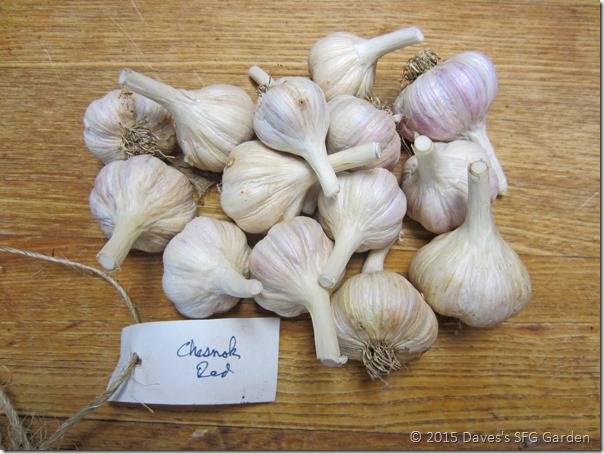
Chesnok Red 15 oz. 15 1 oz. 1.3 oz.
Spanish Roja 29 oz. 21 1.4 oz. 2.6 oz.
German X Hardy 20 oz. 17 1.2 oz. 1.8 oz.
German Red 35 oz. 16 2.8 oz. 4 oz.


German_Extra_Hardy_garlic


German Extra Hardy is one of the first garlics I grew and is a reliable producer every year, although yield seems to be dropping. The first year I got 32 ounces from 4 squares, last year was 18 ounces, and this year I got 20 ounces. I selected some nice sized heads for seed garlic so hopefully next year is better.


This photo shows a trick I picked up from someone. While weighing the garlic I select the heads I am going to save for seed garlic for the fall. Those heads are labeled with a fine Sharpie to identify them and make sure they don’t get selected for dinner.


Spanish_Roja_garlic


This is an example of what not to do with your garlic. The Spanish Roja, normally one of my best garlics, was in a separate bed from the rest and was not quite ready when I dug the other bed. Unfortunately, I forgot about them and harvested them too late. The result was a lot of the bulbs were opening up. In addition, they dried very poorly and as you can see, have a lot of mold I could not get off. I am going to break out a recipe like Chicken with 40 Cloves of Garlic to use these up since they will not keep. In fact. some of the heads are already bad and had to be tossed.


Last year I harvested 33 bulbs from 6 squares weighing 48 ounces, largest one was 2 ounces. This year I got 21 bulbs weighing 29 ounces, with largest bulb at 2.6 ounces. Last year some of the bulbs also did not clean up well and looked a lot like the picture above, so it has a bit to do with the variety.
 

Chesnok_Red_garlic


I like Chesnok Red but it is not performing well in my garden.. This year I got 15 bulbs weighing a grand total of 15 ounces from 4 squares planted 4 per square. Last year I harvested 27 ounces from 4 squares planted  4 per square, which was also down from the year before. I am thinking of replacing this garlic with a different variety next year. However, reading descriptions on some garlic farm websites, it seems Chesnok Red typically produces smaller heads, and they point out the smaller garlics keep better than the larger. Not sure what I will do.


IDuganski_garlic


Duganski is new this year, with seed garlic purchased from Territorial. I was not happy with the bulbs I got from Territorial because they were harvested late, just like my Spanish Roja above, and were coming apart. The cloves germinated just fine and I got a nice harvest, with bulbs being dug at the appropriate time. This was my second largest garlic, coming in behind German Red.


German Red garlic


The German Red garlic did really well. It had the tallest foliage with the thickest stems, which promised big bulbs. That is exactly what it produced, very large bulbs with 4, sometimes 5 cloves. The largest bulb weighed 4 ounces (1 ounce per clove) and the average weight was 2.4 ounces. This garlic was new to me this year. I purchased bulbs at the MDI Garlic Festival last September from Goosefoote Farm of Vermont. They had the same garlic this year and it seemed (eyeball test only) their heads were smaller than last year and smaller than my harvest this year.


I visited the Mount Desert Island Garlic Festival again this year and intended to look for a garlic to replace Chesnok Red. There are so many great varieties, so it is a tough decision. I decided to look for some Phillips (also spelled Philips) garlic and purchased some nice heads from Salty Dog Farm of Milbridge, Maine. Phillips is a Rocambole hard neck variety acquired from a farm in Phillips, Maine by the Scatterseed Project. The farm owner, Raymond Rowe, got his original seed stock from a man in Rome, New York whose parents brought it from Italy when they immigrated to work on the Erie Canal. Besides the local origins and nifty history, this garlic is also supposed to be hardy and a relatively long keeper among Rocamboles. We will see.


While looking for Maine-based sources of the Phillips garlic, I ran across the useful web site of True North Farms in Montville, Maine. They are a large organic garlic grower and can sell seed garlic in large quantities to other garlic growers. Their web site has a lot of useful information for both commercial growers and home gardeners. On the Background tab of their site they show their cultivation practices, which involves a 3-year crop rotation with an elaborate sequence of ground cover crops. The Planting tab has detailed instructions for home gardens (including raised beds) and their recommended process for commercial growers.


Their commercial process was interesting and I learned a few things. Besides their extensive sequence of cover crops, they use certain amendments when planting and during the growing season. These include fish emulsion, humic acid and some of the Quantum Growth products. These are initially applied as a drench and then are sprayed on bi-weekly. The Quantum Growth products supply microorganisms (Rhodopsuedomonas palustris) that are capable of photosyntheis as well as other bacteria (Bacillus amyloliquefacien, Bacillus subtilis, Bacillus licheniformis, and Bacillus megaterium) that protect the plants from disease. In addition, they spray bi-weekly with Procidic, an organic bactericide and fungicide, something I need to start doing. At harvest, they spray an OMRI-approved sodium bicarbonate solution the day before they harvest to tamp down any mildew spores. Overall, an interesting process that might have some application to home gardens.

Monday, August 10, 2015

Harvest Monday 10 August 2015

eggplantandtoms


The story this week is mostly squash and tomatoes, and that is likely to be repeated for the next few weeks. There are three new things in this photo, however. The first cucumber, first eggplant (Ping Tung) and the tomato on the right is a small Pruden’s Purple.  A neighbor in the garden is also growing Pruden’s Purple and has already harvested one that weighed a pound and 3 ounces (about half a kilo). I have two on the vine that should come close to that.


squash&cukes


Some more cucumbers and squash. The cukes are Monika, a Polish pickler. The vines are not looking really good (not from wilt, thankfully) so I am not sure if I will get a lot from them.


tomatoes


A lot more tomatoes. The yellow tomato in the middle is a small Sunkist that was showing signs of anthracnose infection at the stem end, so I picked it. The green tomato is an Opalka that dropped for some reason.


lettuce&tomatoes


I finally cleared out the last of the lettuce so I can try planting carrots in its place. I have more lettuce transplants ready to go in for fall salads.


Red_Zeppelin


Some of the Red Zeppelin onions were falling over and the foliage on the rest looked bad so I declared it time to harvest them. I let them dry in the sun for a few days before taking them home to finish their drying in the garage.


Ice_plant_flowers


Here is a follow-up picture of the crystalline ice plant I described here. The foliage has indeed changed, becoming smaller and more gray in color, with red tips. And it is now flowering. The attractive flowers only last a day and the bees do seem to like them.


That is what happened in my garden last week. To see what other gardeners around the world are doing, visit Daphne’s Dandelions, our host for Harvest Monday.


Monday, July 13, 2015

Harvest Monday 13 July 2015


onions


It seemed like I tried to avoid the garden last week, but a lot happened despite that. Maybe I am just really efficient when I do visit the garden. So this post might be a little long, sorry. Let’s start with onions. The onion thrips essentially killed the White Candy onions so I pulled all of them to get them out of the garden (the white onions at the top). Everything else is doing OK. I pulled a couple of Tropea and Red Candy onions and a Super Star to use in cooking.


chard


I finally uncovered the cucumbers and chard and will take my chances with pests. The chard has again shaded the cukes so I trimmed just the offending leaves on the edges of the chard bed.


mustard_greens


The mustard greens also got a haircut and will probably be removed soon because they are starting to bolt. I may get one more cutting before that happens. I also pulled out all the Soloist cabbages which were riddled with holes and starting to bolt. Planting them without protection turned into a complete waste  of time and space.

Monday, July 6, 2015

Harvest Monday 6 July 2015

beets


I had to clear out some of the beets shading my cucumber plants, resulting in this. Finally, a harvest the wife actually likes, and so do I . Greens get boring after a while. These are Touchstone Gold and Shiraz.


turnips


Next some turnips and the first Azur Star kohlrabi. The white turnips are Hakurei and the others, according to my planting map, are Boule D’Or, but clearly are not. Hmm, where did I plant the Boule D’Or? These are Royal Crown, a purple top F1 hybrid from Sakata I purchased from Pinetree. They look very nice compared to the typical dried out store-bought turnip. Besides being good roasted or mashed, they are a good low-carb substitute for potatoes in some recipes.


lettuce


Finally, I picked some lettuce. I was very bad about planting lettuce this year, but these two did get in the ground. These are Winter Density and Marshall, both Romaines. Unfortunately, they are showing signs of bolting, so I have about a dozen heads to harvest soon. Why did I plant 6 of each?


peas


More peas, and plenty more where these came from. This is 3.5 pounds (1.6 kg). So my plan to trellis them rather than grow them in a block seems to be paying off, and they are much easier to pick. Next year I only need to plant half as many.


onions


The onions are starting to size up, so I need to start pulling and using some of the ones I want fresh (and there are a lot of them). These are Red Candy, Tropea, and White Candy. The White Candy went into the lemon risotto for our Fourth of July salmon. The foliage on the Copra storage onions is already showing signs of falling over. The leaves are very tall and at first I thought it was wind from one of the storms that pushed them over. I think I will be harvesting them soon.


What I also noticed is that many of the onions are showing thrip damage. Onions for me have been pretty trouble free, but last year I figured out I had some apparent thrip damage and even some purple blotch. Thrips are hard to control. They are hard to see, being about a millimeter in size, and they produce 8-10 generations a year. The rapid reproduction means they can quickly develop resistance to whatever you spray them with, so you have to alternate sprays. Apparently spraying Surround clay on onion foliage repels thrips and they can’t build up a resistance to what is a mechanical control. Maybe I will try that next year. I have to find some more uses for my 40 pound bag of Surround.


That is what happened in my garden last week. To see what other gardeners around the world are doing, head over to Daphne’s Dandelions, our host for Harvest Monday.

Template developed by Confluent Forms LLC