Showing posts with label seed catalog. Show all posts

Tuesday, January 27, 2015

Poor Gardening Weather

poor_gardening_weather


It is not very good weather for gardening today. 25 inches at 9 AM this morning and supposed to snow until at least 7 PM tonight.


poor_BBQ_weather


It is even poorer barbeque weather. That’s my poor Weber kettle being engulfed by drifting snow.


wood_stove


While it is a monochrome world outside, it is warm and toasty inside.


seed_catalogs


Color will have to be provided by the seed catalogs. The storm is giving me a day off work and the chance to finalize my seed orders. To add some more color to the process, I loaded the pen with Noodler’s Apache Sunset ink for an in-your-face color addition and reminder of summer days. So I’m happy. I have my seed catalogs, a warm fire, and a glass of Cabernet. Just hope power stays on long enough for me to post this. Everyone stay safe.

Sunday, February 16, 2014

My choices for 2014

seeds_2014


This is a particularly busy time for me. I have a seasonal job doing taxes and I am very busy from mid-January to the end of February, and again the first two weeks of April as the filing deadline looms. At the same time, the seed catalogs have arrived and I have to do the planning and seed ordering for the upcoming gardening season. I did get my seeds ordered and they are starting to arrive. Given the winter we have had so far, it is nice to be able to think about warmer weather and gardening.


Each year I go through the same process, deciding what to grow next season. I have my own experience growing vegetables in my own garden, but the catalogs are very enticing with their color photos and descriptions. I’m also influenced by bloggers who are enthusiastic about a particular variety, and by the kitchen garden at Tower Hill Botanical Gardens, where I can see the variety actually growing in similar conditions to mine. So here is an annotated list of what I am planting in 2014, with an acknowledgement of what/who influenced the choice .

  • Bean Bush – Provider and Jade are my reliable standards and I will be planting them again. The good news on Jade is a new grower has decided to continue to provide seed for the original, so seed vendors can still offer Jade rather than the replacement Jade II, which no one liked.
  • Bean Pole – I will probably still grow some Fortex and Trionfo Violetto, which did well for me last year and are terrific beans. I am going to have to find some room and construct another trellis because I decided to also try some Romano beans, Musica and Gold Marie. These are grown by bloggers I follow and I was envious of  their harvests of these beautiful beans.
  • Beet – I’m growing the red beet Boro again, but will substitute a new variety, Boldor, for Touchstone Gold beet. Here I was influenced by catalog descriptions of Boldor’s better germination rate and vigor.
  • Broccoli – Last year was a tough year for broccoli in our area. We had a hard freeze after I set out the starts, which damaged the leaves and attracted a flea beetle assault. That was followed by weeks of heavy rains, followed by weeks of temperatures in the high 90s and drought. Not ideal weather for broccoli. This year I will try growing Bay Meadows, which is supposed to tolerate some extremes in weather, according to the Fedco catalog.
  • Cabbage Chinese  - Haven’t grown cabbage before because it takes too much room, but have admired some of the Napa cabbages grown by various bloggers. Soloist is a miniature type Napa cabbage that hopefully will fit nicely in a square and even better in a dumpling.
  • Carrots – I had poor results last year with carrots for lots of reasons. I will try again this year and will be adding Yaya to my choices, based on blogger reviews.
  • Cucumber – I will grow Summer Dance and Jackson Classic pickling cucumbers again, based on my own experience with them. I will also grow Crystal Apple again, which did pretty well last year despite horrid conditions. I am adding Richmond Green Apple and Poona Kheera heirlooms to the mix, both impulse buys after reading catalog descriptions. Just have to find some room.
  • Kale – I will be planting Beedy’s Camden again, a great Siberian-type kale that is robust and hardy. Nothing bothers it. I decided to try Nero di Toscana, a kale everyone except me seems to grow, just to see what it is all about.
  • Kohlrabi – I tried kohlrabi last year and it was a failure, just like every other time I tried in the past. Going to try again this year growing Winner, a Fedco recommendation. I was blown away by the Azur Star kohlrabies growing at Tower Hill, but seed is apparently limited by crop failures, so maybe next year if I actually succeed in growing Winner. And this year I will start seeds in soil blocks and transplant to avoid the germination problems I had last year.
  • Mustard Green Wave will be in the garden again. New this year  is Dragon Tongue, a purple mustard from Territorial.
  • Onion – My Copra and Red Bull onions were pretty successful last year and the few remaining in the basement are still  in good condition. This year I am going to try Patterson, a yellow storage onion from Johnnys, and Red Wing (which was unavailable last year after a crop failure). Add to that the Saffron shallots, which I will try to grow from seed after last year’s expensive failure with fall-planted shallot bulbs. And I am trying Pride bunching onions from High Mowing, another impulse catalog purchase.
  • Pea Snow and Snap – The Oregon Sugar Pod II snow peas will be in the garden again. This year I am trying Sugar Daddy snap peas, which have short vines and good flavor, according to the catalogs. I prefer to grow the peas in self-supporting blocks rather than trellis them, saving precious trellis space for pole beans and cucumbers.
  • Peppers – Did I mention that last year’s weather conditions were horrid? A late Spring, cold weather including some freezes delaying planting, torrential rain storms and flooding, disease and pests, and weeks of weather near 100F made gardening here a challenge and affected my peppers. Still I had a fairly successful pepper season. I think some  of the success had to do with my new pepper protocol. Peppers I will surely grow again this year include Jimmy Nardello, Pimiento di Padron, Tiburon Ancho, Lipstick and Red Cherry. Two new ones I am trying are described as “spice” peppers, Aji Dulce and Trinidad, from Southern Exposure Seed Exchange. These are supposed to have the aroma and flavor of hot peppers like Habanero without the heat. Trying the first one should be interesting, who’s volunteering?.
  • Radish – With the crappy weather, radishes didn't do well for me last year. I will probably try some again this year. New to the list is a radish I saw growing at Tower Hill, called Bora King. It is an elongated radish with a beautiful purple color and purple flushes on its foliage. I also bought on impulse some seed for Zlata. a Polish heirloom with a brown skin.
  • Squash Summer – The PM was horrid last year and the strain we had was resistant to most methods of controlling it. Even resistant varieties like Dunja were challenged. Hope this year is better. I still think Dunja is an excellent variety, but this year I convinced myself to try Desert, an exclusive from High Mowing. It is similar to Dunja but can still produce during extremely hot weather like last year. I was put off by the price of $7.50US for 10 seeds but decided that was just the price of supporting local seed companies who develop new varieties that suit my climate. Another experiment this year is substituting Y-Star for Sunburst as my yellow patty pan. I’m still a big fan of Sunburst but wanted to try Y-Star. Costata Romanesco and Tromboncino will still be in the garden.
  • Swiss chard – I’m trying Magenta Sunset this year, which I admired in the garden at Tower Hill. I will still be growing Orange Fantasia with it.
  • Tomatoes – Tomatoes are a big topic. In my SFG, I am growing indeterminate varieties 1 per square, a single leader trained up a trellis. This works but I have had limited results, a topic that will be covered in Part 2 of my What Works, What Doesn’t blog, if I ever get around to writing it. Meanwhile, I have plans to grow 7 varieties of tomatoes this year: 1) Juliet is a favorite that did very well last year in horrid weather. I considered trying Verona, a Johnny’s variety that claims to be Juliet-like with larger size and better flavor, but decided against it this year. 2) Sungold is another favorite but prone to cracking. This year I will try Esterina instead, a yellow cherry  from High Mowing that claims to be sweeter and more crack resistant than Sungold. 3) Jaune Flamme, a French heirloom grown by Michelle and other bloggers, will be given a chance. Another impulse decision, 4) Sunkist, an orange medium-sized slicer from High Mowing that was bred In New Hampshire, will hopefully produce some tasty tomatoes. 5) I saw Opalka growing at Tower Hill and was very impressed with the plant and the fruit. This is a Polish-origin heirloom paste tomato that will replace Gilbertie and Striped Roman in my garden. Hopefully it does better than those two, from which I failed to get more than a single tomato last year. 6) I love the flavor of Black Cherry, but the last two seasons have produced a meager harvest from plants that struggled with weather and disease. This year I am trying Black Pear, an impulse buy from Baker Creek Seeds. 7) Finally, I am going to plant Big Beef again for a main slicer tomato. I hope to buy plants locally so I don’t have to start these myself.
  • Turnips – I had some luck with Golden Ball last year but this year I will be growing Jaune Boule d’Or, a French heirloom from Baker Creek. Add to that the Japanese white turnip, Hakurei, from Johnny’s, in place of Tokyo Cross, which didn’t even germinate last year.

Wednesday, July 3, 2013

Baker Creek Heirloom Seeds

During my recent trip to Missouri I was able to visit one of my favorite seed suppliers, Baker Creek Heirloom Seeds, which is located on a gravel road about 5 miles north of Mansfield. The farm is open to visitors and has a restaurant, a reproduction  pioneer village called Bakersville,  and a seed store that are free to visit. I had no idea where Mansfield was until I looked at a a map and discovered it was about an hour east of Springfield where I would be visiting my sister. So I arranged to visit with my niece and we had a great time. It turns out that Mansfield is also home to the Laura Ingalls Wilder Historic Home & Museum, the author of the Little House on the Prairie. If you have a Little House fan in your household, the museum and Bakersville would make a wonderful day trip and it is only 90 minutes from Branson.


The first structure we encountered on entering the gate was the restaurant, housed in the simulated hotel, which was fortunate because my niece had missed breakfast and was starving.


restaurant


The vegan meal we were served would certainly fill up anyone. They have a fixed menu and that day the meal was a vegan chimichanga with fresh salsa, Mexican rice, a garden salad with lots of sliced radishes, and steamed heirloom beets (golden and Chioggia), with a mason jar of three berry iced tea and zucchini cake with cream cheese frosting. Payment is by donation, putting what you wish into a jar up front. The meal was excellent (even if a carb bomb) and you would certainly have enough energy to plow the south forty after that lunch.


lunch


After lunch we toured the village. The stores were furnished with appropriate fixtures and merchandise that can be purchased. The apothecary shop had dried herbs and medicinals and home remedies for sale. The mercantile store had handmade girl’s gingham dresses with aprons and bonnets for sale, plus bolts of cloth and patterns. Anyone with an interest in Little House on the Prairie would love the place.
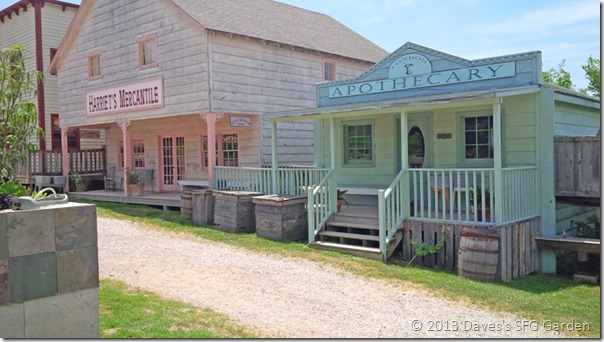
 

stores


old_barn


Following the road around the demonstration garden in the center brings you to the seed store, where you can pay for your items and browse through a large display of seeds. I purchased the Baker Creek Vegan Cookbook and some handmade pot holders, plus a couple of packs of bush beans for my sister’s garden.


seed_store


The other side of the road has the buildings used in seed operations plus some of the trial fields. I did not see lots of fields planted to seed crops but I assume a lot of their production is contracted out to local growers. If everything looks hot and dry, it was hot and dry and the temperature that day was at least 97°F/36°. 


seed_operations


Baker Creek Seeds was founded by Jere and Emilee Gettle, a young couple that project an image of Ozark hillbilly but are actually very shrewd business people. They own the largest heirloom seed company and also own Comstock-Ferre Seeds in Connecticut and the Petaluma Seed Bank in California. I was suspicious of their large, glossy and expensive seed catalog (they print 350,000 copies a year), so I assumed they must have some corporate connection or inherited some money, but no, Jere and Emilee built their fortune on their own. Jere became fascinated with heirloom vegetables as a boy after reading about a tomato variety that was grown by Thomas Jefferson. He joined the Seed Savers Exchange, started trading seeds with other enthusiasts and issued his own price sheet in 1998 when he was 17. They are strong advocates for open pollinated, non-hybrid vegetables and strong opponents of GMO crops and Monsanto. They are the real deal and you can feel good buying seeds from Baker Creek.

Friday, December 14, 2012

First Seed Catalogs Arrive

Not even the winter solstice yet and I have three seed catalogs in hand from three of my favorite seed companies and a fourth catalog arrived today. Of course, the holidays are keeping me busy so I may not get to fully enjoy them until after New Years. Still, I am able to occasionally flip through them, circling items that catch my eye.

PT
First to arrive was the Pinetree catalog. Pinetree is a small, family-owned business in Maine that I have patronized for years. Besides the fact they are a local family business, they have other virtues. They offer small, inexpensive packets of seeds, some as low as 95 cents. Usually I don’t need a thousand seeds for my SFG and I don’t need to pay $3-4 for it. The Pinetree packets also give planting instructions in SFG terms, seeds per square foot, rather than seeds per foot of row. And Pinetree’s selection of seeds is good and includes desirable selections from breeders such as Johnny’s as well as heirloom and imported varieties. I have circled the Trionfo Violetto pole bean and the Tromboncino squash in this year’s catalog.


Johnnys
Next to arrive was the Johnny’s catalog. Johnny’s is another Maine-based seed house I have used for years. They grow their seeds in northern Maine and are active breeders of new varieties (like Bright Lights chard and Lipstick pepper). I like this and believe they are offering varieties that will succeed in northeast summers. Their catalog is full of technical information and is a valuable resource throughout the season. And being a victim of some bad seed, I like that Johnny’s certifies that their bean seeds are 100% halo blight free.  The downside is that their packets are expensive, but sometimes they are the only source for some of the newer varieties. This year they have a new cherry tomato, Jasper, which they bred and which won the AAS.


BC


The Baker Creek Heirloom Seeds catalog showed up next. It is a large, beautiful catalog printed on glossy coated paper with gorgeous photography. While slick and glossy and technically up-to-date (they Facebook and have an iPhone app), Baker Creek is dedicated to offering heirloom and organic seed free of GMOs and are heavily involved in the battle against GMO crops and corporate agriculture. They are located in Mansfield in southwest Missouri, east of Springfield. I get that way every year or so to visit my sister and I plan to make a detour through Mansfield next time. It’s not surprising given their location they are specialists in warmer weather crops. Their selection of eggplant, melon, squash and tomato varieties is probably unmatched.


SESE_2013
While I was writing this article the Southern Exposure Seed Exchange catalog arrived. I purchased my shallot bulbs from them last Fall. They produce a beautiful catalog with color photographs printed on recycled newsprint. The cover shows garden gnomes in a raised bed garden. They are located in Virginia and carry varieties that are optimal in the southeast US but most are generally useful for other areas. They have a good selection of southern heirloom varieties of greens (mustards, collards, turnip), beans, limas, okra, cowpeas, peanuts, melons, and tomatoes. They also carry a good selection of shallots, garlic, and a variety of multiplier and potato onions. Finally, they are dedicated to safe seed, GMO free, open-pollinated and organically grown where possible.
fedco
I have to mention Fedco Seeds, even though I don’t get a printed catalog from them, I just download the catalog. Fedco is a co-operative in Maine that is dedicated to organic, open-pollinated and untreated seed. They are also part of the lawsuit against Monsanto. They have a good selection and good prices. In addition, they accept group orders. Our community garden organization puts together a group order in late winter which gets everyone a discount and reduced shipping cost plus the organization makes a few bucks off the order. One item of note is that Fedco carries seed for Beedy’s Camden kale, which is a great kale variety to grow. Another thing I like at Fedco is their Mesclun mix, which is packed in two separate envelopes containing the mustards and the lettuces. Since the lettuces are slower to germinate and grow, you plant them a week or two earlier in a separate bed from the mustards.
Template developed by Confluent Forms LLC